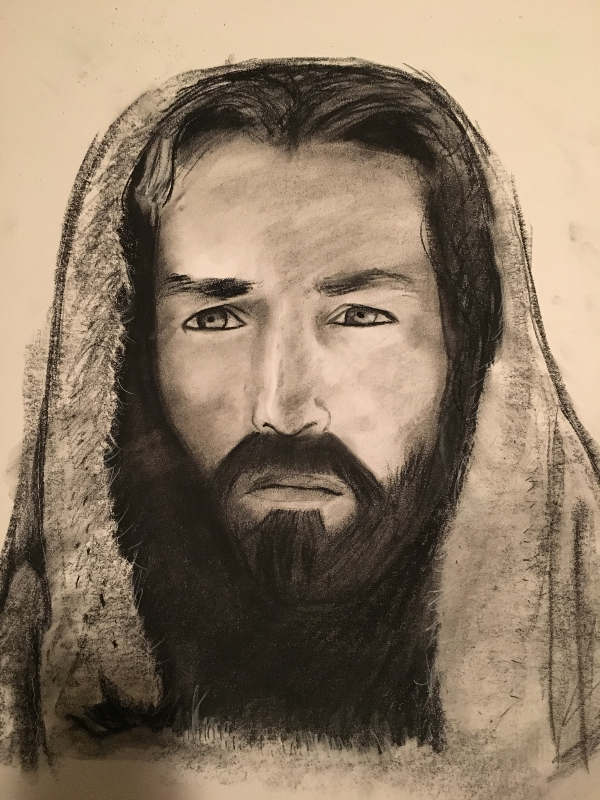
…A remembrance, on this weekend of “Palm Sunday”….
“Rejoice greatly, O daughter of Zion! Shout O daughter of Jerusalem! Behold, your King is coming to you; He is just and having salvation, lowly and riding on a donkey, a colt, the foal of a donkey.” Zechariah 9:9
We thought He would be the King of Israel, riding on a donkey, He came…
Instead, He was heading towards Calvary’s cross. There, He would be taking the blame…
for my sins and those of the entire world–God’s gift of salvation for all.
We waved our palm branches before Him–so worthy, for He was following His Father’s call.
P. A. Oltrogge
(the above from Matthew 21)
“Now My soul is troubled, and what shall I say? ‘Father, save Me from this hour’? But for this purpose I came to this hour. Father, glorify Your name.”
“Then a voice came from heaven, saying, ‘I have both glorified it and will glorify it again.’” John 12:27-28
“For God so loved the world that He gave His only begotten Son, that whoever believes in Him should not perish but have everlasting life.” John 3:16 Scriptures: NKJV
From then on, Jesus began to tell people, “TURN TO GOD AND CHANGE THE WAY YOU THINK AND ACT, BECAUSE THE KINGDOM OF HEAVEN IS NEAR!”
Jesus went all over Galilee. He taught in the synagogues and spread the Good News of the Kingdom. HE ALSO CURED EVERY DISEASE AND SICKNESS AMONG THE PEOPLE.
The news about Jesus spread throughout Syria. PEOPLE BROUGHT HIM EVERYONE WHO WAS SICK, THOSE WHO SUFFERED FROM ANY KIND OF DISEASE OR PAIN. THEY ALSO BROUGHT EPILEPTICS, THOSE WHO WERE PARALYZED, AND PEOPLE POSSESSED BY DEMONS, AND HE CURED THEM ALL.
Large crowds followed Him. They came from Galilee, the Ten Cities, Jerusalem, Judea, and from across the Jordan River. (Matt. 4:17; 4:23-25 – GW)
Matt. 4:17… FROM THEN ON, Jesus BEGAN to tell people, “TURN TO GOD AND CHANGE THE WAY YOU THINK AND ACT, BECAUSE THE KINGDOM OF HEAVEN IS NEAR!”
This portion of scripture reprinted, with emphasis by Rev. Kevin Kinchen
All that one needs to do is to listen briefly to the daily news to realize there are many people who need to change their views…
to change the way they think and act–in repentance, turning to the Lord. And to those who seek Him diligently, He promises His reward.
P. A. Oltrogge
“But without faith it is impossible to please Him, for he who comes to God must believe that He is, and that He is a rewarder of those who diligently seek Him.” Hebrews 11:6 NKJV
“And Jesus went out, along with His disciples, to the villages of Caesarea Philippi; and on the way He questioned His disciples, saying to them, ‘Who do people say that I am?’ And they told Him, saying, ‘John the Baptist; and others say Elijah; but others, one of the prophets.’ And He continued by questioning them, ‘But who do you say that I am?’ Peter answered and said to Him, ‘Thou art the Christ.’ And He warned them to tell no one about Him.
“And He began to teach them that the Son of Man must suffer many things and be rejected by the elders and the chief priests and the scribes, and be killed, and after three days rise again. And He was stating the matter plainly. And Peter took Him aside and began to rebuke Him. But turning around and seeing His disciples, He rebuked Peter, and said, ‘Get behind Me, Satan; for you are not setting your mind on God’s interests, but man’s.'” Mark 8:27-33 NASB
________________________________________________
“But who do you say that I am?” Jesus asked His disciples….
Peter’s answer to the Lord that day was that He was the Christ, which was exactly right. But, thereafter, he spoke amiss, for he hadn’t yet fully discerned the Lord’s role in the world’s most important spiritual fight.
“Get behind Me, Satan…” was Jesus’ firm rebuke….
Peter had doubts in obeying Jesus, to cast out his fishing nets, having worked all night; yet, in another instance, he boldly walked on the water to meet Him, but, then, gave in to fright….
Again, at the Last Supper, when the Lord came to Peter to wash his feet, he didn’t initially understand the Father’s direction that Jesus was wanting to meet.
Then, when he denied the Lord three times after Jesus had been seized and led away, he became an example of one who repents and goes on to serve God, receiving mercy for a “new day.”
After Jesus’ resurrection, Peter eagerly jumped from his boat into the water to meet the Lord who had appeared on the shore. There, Jesus asked him three times if he loved Him, knowing he would love and serve Him now all the more.
Peter indeed went on to “feed My sheep” as Jesus, his Lord, had made request. We, too, though imperfect followers of Christ, can carry forth the gospel’s work, so that others will be blessed.
P. A. Oltrogge
“He said to him the third time, ‘Simon, son of Jonah, do you love Me?’ Peter was grieved because He said to him the third time, ‘Do you love Me?’
“And he said to Him, ‘Lord, You know all things; You know that I love You.’
“Jesus said to him, ‘Feed My sheep.'”
John 21:17 NKJV
(And from John 13:1-17; Matthew 26:31-35; John 13:36-38; Matthew 26:69-75; Luke 22:54-62)
And when He saw the multitudes, He went up on the mountain; and after He sat down, His disciples came to Him. And opening His mouth He began to teach them, saying,
“Blessed are the poor in spirit, for theirs is the kingdom of heaven.
“Blessed are those who mourn, for they shall be comforted.
“Blessed are the gentle, for they shall inherit the earth.
“Blessed are those who hunger and thirst for righteousness, for they shall be satisfied.
“Blessed are the merciful, for they shall receive mercy.
“Blessed are the pure in heart, for they shall see God.
“Blessed are the peacemakers, for they shall be called sons of God.
“Blessed are those who have been persecuted for the sake of righteousness, for theirs is the kingdom of heaven.
“Blessed are you when men cast insults at you, and persecute you, and say all kinds of evil against you falsely, on account of Me.
“Rejoice, and be glad, for your reward in heaven is great, for so they persecuted the prophets who were before you.
“You are the salt of the earth; but if the salt has become tasteless, how will it be made salty again? It is good for nothing anymore, except to be thrown out and trampled under foot by men.
“You are the light of the world. A city set on a hill cannot be hidden.
“Nor do men light a lamp, and put it under the peck-measure, but on the lampstand; and it gives light to all who are in the house.
“Let your light shine before men in such a way that they may see your good works, and glorify your Father who is in heaven.”
The following is the story of Rev. E. P. Scott and the hymn, “All Hail the Power of Jesus’ Name,” (written by Edward Perronet).
This beautiful hymn on the power of Jesus’ name was used by a missionary; and he found it to tame… a known, dangerous tribe, which he was endeavoring to reach, in the Indian subcontinent, where he desired to teach.
He wanted to share Jesus, of whom they’d not heard, knowing that “Go into all the world” was the Lord’s Word. Though warned by some friends against going to that area of land, he followed the Holy Spirit, regardless, and met with a band…
of warriors, who surrounded him, pointing their spears. But he took out his violin, actually, despite obvious fears. He began with the words, “All hail the power of Jesus’ name.” To that name, “let every kindred, every tribe” lay claim!
Having closed his eyes while singing, in their language, the song, upon opening them, it was clear that Jesus’ name had been strong. God’s Spirit, thereby, had quenched any dreaded attack; they’d lowered their weapons–shedding tears, sensing their lack.
For the following two years, the minister taught his new friends of Jesus, the Savior, on whom the soul’s cleansing depends. Not just for eternity, but God cares for His children here and now. They become heirs through the name, to which every knee should bow!
P. A. Oltrogge
“Therefore God also has highly exalted Him and given Him the name which is above every name, that at the name of Jesus every knee should bow, of those in heaven, and of those on earth, and of those under the earth, and that every tongue should confess that Jesus Christ is Lord, to the glory of God the Father.” Philippians 2:9-11 NKJV
“Nor is there salvation in any other, for there is no other name under heaven given among men by which we must be saved.” Acts 4:12 NKJV
___________________________________________
ALL HAIL THE POWER OF JESUS’ NAME
All hail the power of Jesus’ name! Let angels prostrate fall; Bring forth the royal diadem, And crown Him Lord of all; Bring forth the royal diadem, And crown Him Lord of all.
Ye chosen seed of Israel’s race, Ye ransomed from the fall, Hail Him who saves you by His grace, And crown Him Lord of all; Hail Him who saves you by His grace, And crown Him Lord of all.
Let every kindred, every tribe, On this terrestrial ball, To Him all majesty ascribe, And crown Him Lord of all; To Him all majesty ascribe, And crown Him Lord of all.
O that with yonder sacred throng, We at His feet may fall! We’ll join the everlasting song, And crown Him Lord of all; We’ll join the everlasting song, And crown Him Lord of all!
“Top of the morning” to you, on this St. Patrick’s Day! May all of God’s wonderful blessings graciously come your way.
It’s said that St. Patrick used the shamrock, which has leaves of three, as an illustration to the Irish people of God’s holy Trinity.
Just as a shamrock is composed of three separate leaves, yet is one– the almighty God of the Bible is the Father, Holy Spirit, and the Son.
Shamrocks have been associated with “luck,” but God’s promises are sure. While shamrocks cannot last, God’s loving kindness will forever endure.
Today is a day when many will turn to thoughts of the Emerald Isle; but may we daily be sure to turn our thoughts to the Lord for a while.
And on a day when some may be thinking of “wearing the green,” may the people of God reflect His joy, which is the best thing to be seen.
P. A. Oltrogge
“…for the joy of the Lord is your strength.” Nehemiah 8:10
“For there are three that bear record in heaven, the Father, the Word, and the Holy Ghost, and these three are one.” 1 John 5:7 KJV
Of the Word, Jesus, it’s written: “And the Word was made flesh, and dwelt among us, (and we beheld his glory, the glory as of the only begotten of the Father,) full of grace and truth.” John 1:14 KJV
Mark 12:28-30; John 14:6; John 14:9; 1 John 1:1-4; John 1:1-5
Please, dear friend, be rich towards God, thinking not only of your own pursuits; But think about turning your heart to Christ and others, putting down good spiritual roots. For what will it profit a man if he gains the whole world, but forfeits his own soul? Helping others spiritually and in tangible ways is God’s plan, in which we’re all to have a role.
Have you spoken to Jesus in a personal way today, or do you just run out to meet the day? A relationship with Him makes a difference for the better–it’s wise to take time to pray. One day Jesus will be coming back in glory and will repay His saints for selfless deeds. Not only for that reason, but for the joy that’s returned, ask Him to show you another’s needs.
God’s not against your having enjoyment of certain things… But doesn’t want you to miss the fulfillment which living for Him brings.
P. A. Oltrogge
“For whoever wishes to save his life will lose it; but whoever loses his life for My sake will find it. For what will it profit a man if he gains the whole world and forfeits his soul? Or what will a man give in exchange for his soul? For the Son of Man is going to come in the glory of His Father with His angels, and will then repay every man according to his deeds.” Matthew 16:25-27
“But God said to him, ‘You fool! This very night your soul is required of you; and now who will own what you have prepared? So is the man who stores up treasure for himself, and is not rich toward God.” Luke 12:20-21
“Knowing What Belongs to Us” by Kenneth E. Hagin is a booklet which shares the benefits we have, in turn, as believers…available at http://www.rhema.org under “Bookstore” and emphasizes Ephesians 1:3, “Blessed be the God and Father of our Lord Jesus Christ, who hath blessed us with all spiritual blessings in heavenly places in Christ.”
Reprinted with permission given from Zola Levitt Ministries….
The following is an essay on the most asked question that comes to Zola Levitt Ministries during the season of Lent/Easter, when you may ask it yourself.
Friday to Sunday?
QUESTION: If the Lord was crucified on Friday and rose on Sunday, how could that encompass three days and three nights?
ANSWER: The Gospel accounts indicate that the Lord was crucified on Friday at 9:00 a.m. and taken off the cross at 3:00 p.m. His body was prepared for burial and interred at sundown the same day, which was the beginning of the Festival of Unleavened Bread. The Lord then arose on Sunday morning after sunup.
According to the modern way of counting, this spans barely two days. Yet that time period seems to disagree with Jesus’ earlier prediction:
“For as Jonas (Jonah) was three days and three nights in the whale’s belly; so shall the Son of man be three days and three nights in the heart of the earth.” Matthew 12:40
The prophecy can be understood when we examine the Jewish way of counting days and nights. We must recall that the Jewish day always starts at sunset, so that Friday really begins on Thursday evening (a fact that is reflected in the language of Genesis–“the evening and the morning” are the first day). The second day, then, begins at sundown on Friday and continues through the daytime on Saturday. Finally, Sunday begins at sundown on Saturday and stretches through Saturday night and the daylight hours of Sunday, making the third day. Since the Jews counted any portion of daylight as a full day, then Friday morning through Sunday morning would have been seen as three complete days and nights.
People have sometimes struggled to move Passover (the “Last Supper”) back one day in order to get three days and three nights the way we would count them in the Western world, but that would be inaccurate. Even in the Western world we begin each day on the night before at midnight, so the concept is not strange to us. Supporting this understanding of the Lord’s crucifixion on a Friday (against those who claim that it happened on a different day) is the centuries-long history of Christians celebrating Good Friday, not “Good Thursday” or “Good Wednesday.” This evidence indicates that we can trust the accuracy of the Bible’s account, and also confirms that knowing the Jewish roots of Christianity can open a deeper understanding of God’s Word.
Do the Gospels Disagree on When Jesus Died?
QUESTION: Did Jesus celebrate the Passover and die on Passover day, or did He celebrate and die on the day before? Matthew, Mark, and Luke say He died on Passover day, but John seems to claim that He celebrated and died the day before the Passover. Why the difference?
ANSWER: The difference between John’s Gospel and the Synoptic Gospels (Matthew, Mark, and Luke) regarding the Passover and death of Jesus is attributable to the fact that two systems were used at that time for reckoning Passover day. The Judeans used a method of reckoning different from the Galileans (Matthew, Mark, and Luke). The Galileans and Pharisees measured days from sunrise to sunrise, whereas the Judeans and Sadducees used the sunset-to-sunset reckoning in John’s Gospel.
“And the evening and the morning were the first day.”–Genesis 1:5
Thus, Jews from Galilee celebrated their Passover on Thursday evening, with Passover day starting at sunrise Friday morning. Jews in Judea and Jerusalem, however, celebrated Passover on Friday evening at sundown. Consequently, according to John and the Jews in Judea, Jesus’ celebration on Thursday and death on Friday before sunset occurred on erev Pesach (the eve of Passover), because Passover started for them at Friday’s sunset.
The Galilean method used by Jesus and His disciples would have the Passover Lamb slain and Last Supper on Thursday, 14 Nissan. The Judean method used by John would have the Passover Lamb slain on 15 Nissan.
Most scholars agree that because of the two different methods of timekeeping, there were two days for the slaying of the lambs, which makes sense given the number of lambs being slaughtered. That task couldn’t be done in a single day.
There is no contradiction; the Gospels reflect the two different chronological systems for determining the Passover.
The capital of the Assyrian Empire was Nineveh, and the Assyrians showed no mercy to those they overtook in any conquest.
God told His prophet, Jonah, that he should go to them, telling them to repent for their sins and idolatry, at the Lord’s request.
Jonah didn’t want to do this. They were Israel’s enemies; and, in his own way of thinking, they deserved to be punished without being warned.
So he set off for the seaport of Joppa and boarded a ship due to sail to distant Tarshish–the mission for God being thereby scorned.
Jonah went below and soon fell fast asleep, while the crew, above on deck, began to grapple with a storm that had begun to grow.
They tried very hard to keep things on course, but eventually decided the way to survive was that much of the cargo they’d have to forgo.
They perceived that such a fierce storm had something to do with God and began to pray to “gods” which they’d known by hearsay.
That didn’t prove to help and they thought of the passenger who’d come aboard, all the while they were dealing with wind, waves, and spray.
The captain went below and found, despite the storm, the new passenger asleep; and he woke him to pray to his “god,” or they’d all be lost.
A decision was made to cast lots to see who was to blame for the trouble, and they came up with Jonah as the cause of their being storm-tossed.
Jonah admitted to being a Hebrew from Israel–one who worshiped the true God who’d made heaven and earth, but whom he’d disobeyed.
He said he’d run away from a God-ordained task. The storm was surely because of that–and, therefore, a decision had to be made.
The only way to stop the storm’s fury, he said, was to throw him overboard; but the sailors ignored that, not wanting to do such a cruel act.
They tried taking to the oars, which ultimately didn’t work; so they finally took Jonah at his word, so their ship could remain intact.
They prayed that Jonah’s God wouldn’t harm them for taking the measure, but went ahead and tossed him over the threatened boat’s side.
Then the winds began to die and the waves to calm…. They gave thanks and honored his God on the deck in awe, that the storm did, in fact, subside.
As Jonah began to tumble down into the depths of the water, he knew he needed to call on God to rescue him from the harrowing situation.
So God appointed a great fish, of His design, to come and scoop him up in its mouth, providing an unusual underwater way station.
“I called out of my distress to the Lord, and He answered me. I cried for help…from the depth of Sheol, Thou didst hear my voice,” Jonah said.
“Water encompassed me to the point of death. The great deep engulfed me.” But his salvation was from the Lord, whom he thanked for life instead.
After three days and nights, God commanded the fish to release Jonah out onto the dry land; and he heard the Lord say that Nineveh was still on His mind.
The message to repent before forty days’ time or God would punish them and their city was to be presented to all. This time Jonah went, but never whined.
Well, the people’s hearts were receptive to the message that Jonah brought; and from the King down to the least, they fasted from water and bread.
They were repentant and called on God that He might relent and not harm them after all–and God, in His mercy, didn’t do what Jonah had relayed that He had said.
This displeased Jonah, who hadn’t had a heart for the people from the beginning of the assignment. He told God that He was too gracious as far as he could tell–
“a compassionate God, slow to anger, abundant in loving kindness, and one who relents concerning calamity.” (It was Jonah’s anger that began to swell.)
The Lord asked Jonah if he had good reason to be angry; but Jonah simply exited the city to watch if their repentance would last, or if God might yet send destruction.
After all, he felt the Ninevites didn’t deserve any mercy since they’d not shown any themselves. He kept fuming since he’d followed God’s every instruction.
While he was outside the city waiting to see if God would send, at least, some punishment to it, God provided a plant there to shade him from the sun.
This pleased Jonah very much. But God had a lesson in mind and sent a worm to destroy the plant the next morning, and its leaves withered to none.
Again, Jonah became upset and complained that his life wasn’t even worth living. Then, the Lord said that if he was sad about a mere plant’s death,
which he hadn’t even created, wasn’t He, as the Lord of creation, justified in caring about 120,000 persons to whom He’d given breath?
So we see that God uses messengers to cause men to repent and turn away from wrong–that there loom consequences to ignoring the true God and His ways.
But He does this out of the love He has for those whom He’s designed and created, simply wanting them to come under His kindness and blessing all of their days.
Thank God, there are many “Jonahs” today, sharing the message that Jesus is the way, the truth and the life. More eager to do so than Jonah, they hope to reflect…
the love and mercy of the Lord themselves–and that God’s words through the Bible reveal that Jesus Christ is faithful, and so worthy of every person’s respect.
P. A. Oltrogge
Just as Jonah was in the belly of the fish for three days and three nights, Jesus said that would be the “sign” to “this generation.” He said this, knowing and meaning He would be put to death on a cross for the sins of mankind and would be in the grave for three days and three nights, but would be resurrected then, with the accomplished, triumphant message that salvation is of Him, Jesus Christ. He told the crowds, “Something greater than Jonah is here!” And so, He is here today. May this present generation fully embrace the message of His life, death, and resurrection and offer of forgiveness and abundant life now and for eternity.
“And as the crowds were increasing, He began to say, ‘This generation is a wicked generation; it seeks for a sign, and yet no sign shall be given to it but the sign of Jonah. For just as Jonah became a sign to the Ninevites, so shall the Son of Man be to this generation. The Queen of the South shall rise up with the men of this generation at the judgment and condemn them, because she came from the ends of the earth to hear the wisdom of Solomon; and behold, something greater than Solomon is here. The men of Nineveh shall stand up with this generation at the judgment, and condemn it because they repented at the preaching of Jonah; and behold, something greater than Jonah is here.’” (words of Jesus, from Luke 11:29-32 and Matthew 12:38-41)
“For God so loved the world, that He gave His only begotten Son, that whoever believes in Him should not perish but have eternal life.” John 3:16
“He isn’t really being slow about His promised return, even though it sometimes seems that way. But He is waiting, for the good reason that He is not willing that any should perish, and He is giving more time for sinners to repent.” 2 Peter 3:9 The Living Bible
“He is merciful and tender toward those who don’t deserve it; He is slow to get angry and full of kindness and love.” Psalm 103:8 The Living Bible
“For God has shut up all in disobedience that He might show mercy to all. Oh, the depth of the riches both of the wisdom and knowledge of God. How unsearchable are His judgments and unfathomable His ways!” Romans 11:32-33
I once saw a film clip about a shepherd of today. It showed an imposter calling for the sheep to come his way.
But the sheep went on grazing, just as if they couldn’t hear. Then their true shepherd called. His voice, to them, was clear.
It was amazing to watch them immediately flock to his side. Likewise, we flock to our true Shepherd, protector, and guide.
At times, a voice that is dangerous will come to us in disguise. But the voice of our Shepherd, Jesus, and His truths make us wise.
P. A. Oltrogge
“And when he brings out his own sheep, he goes before them; and the sheep follow him, for they know his voice. Yet they will by no means follow a stranger, but will flee from him, for they do not know the voice of strangers.” John 10:4-5
“I am the good shepherd; and I know my sheep, and I am known by my own.” John 10:14
“…For He Himself has said, ‘I will never leave you nor forsake you.’” Hebrews 13:5
“The wise in heart will receive commands….” Proverbs 10:8
“The law of the wise is a fountain of life, To turn one away from the snares of death.” Proverbs 13:14
“But the wise took oil in their vessels with their lamps.” from one of the parables in Matthew 25 (verse 4)
Scriptures NKJV
Refer to: www.sidroth.org for an interview with Tracy Eckert on hearing Jesus, our Good Shepherd’s, voice and other insights. Other excellent interviews are also featured.